TRUST – (Threat and Risk Understanding Strengthens Teamwork) Training Program
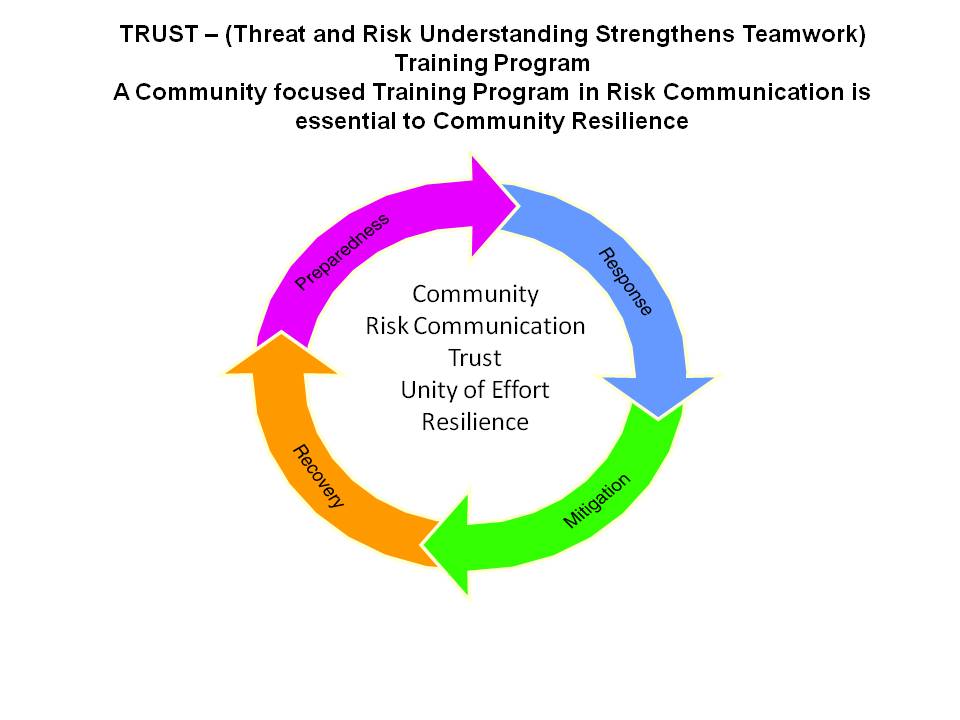
TRUST – (Threat and Risk Understanding Strengthens Teamwork) Community based Training in Risk Communication is essential to Community Resilience.
This past Spring I attended a Hurricane Preparedness Workshop, and could not help but notice how little "diversity" was represented in that large gathering of one State's emergency management directors. It raised the question on the issue/potential for targeting and outreach to specifically challenged socio-economic groups, and how faith based and community groups were a very viable option for that type of "preparedness market segment" communication. As the White House’s initiative focuses on “Faith-Based and Community Groups Get Active in Emergency Preparedness” http://www.whitehouse.gov/blog/2010/10/26/faith-based-and-community-groups-get-active-emergency-preparedness-0
Just building trust alone for a "coalition of the prepared" in those groups, along with proper approach for "risk communication" within those groups and communities are crucial challenges, as you surely appreciate.
NEEDED – targeted RISK COMMUNICATION training within communities.
The critical path to Community Resilience is TRUST. (Schoch-Spana, 2008). "Resilience… a National Security, Economic Competitiveness and Civil Society Imperative" (Stephen Flynn, 2010). Dr. Stephen Flynn, President of the Center for National Policy, "I applaud President Obama's inclusion of resilience in the new National Security Strategy. This marks an important step forward by acknowledging the vital role that citizens, companies, and communities can and must play in dealing with the evolving terrorism threat highlighted by the recent Times Square attack and the ongoing risk of natural disasters. I sincerely hope this new strategy inspires a revitalized national effort to better integrate the role of everyday Americans and the private sector into security and preparedness planning."
Community resilience is the ability of a community to rebound from an incident, event, or disaster with a new focus on recovery and mitigation and a renewed sense of trust in community leadership and in government.
Trust is a pre-requisite for effective preparedness orientation and action within a community.
Leadership and followership is a choice for action and trust is tantamount to that choice.
The key enabler to TRUST is the ability of the community to use risk communication tools and strategies to enhance pre-incident knowledge, pre-event preparedness and post-event recovery.
The enabling link between risk analysis and risk management is risk communication.
Three major elements of risk communication must be met:
-Advocacy: Being able to create an environment based on trust and credibility that persuades the audience to follow the best scientific information.
-Education: To produce an informed audience; i.e., to give people enough information so they can make better and more informed decisions about risk-reducing behaviors.
-Decision-making: To involve the audience in the process.
Trust and Credibility. In recent years, the Gulf/Deepwater Horizon Oil Well Spill, KATRINA, Exxon Valdez oil spill in Prince William Sound (Alaska), and the Bhopal chemical incident (India)) have made the public perceive that companies and their government cannot be trusted to carry out their responsibilities. Risk communication is often riddled with suspicion, therefore, initial strategies are needed that build trust. Once trust is destroyed by events such as accidents, lies, discoveries of errors, or mismanagement, there is a tendency to perpetuate and reinforce distrust (Slovic 1993).
According to the Homeland Security Presidential Directive-21 (HSPD-21), resilience is essential to limiting the need for prolonged assistance post disaster. In order to improve resilience, Bruneau (2003) argues that communities must build capabilities that are characterized by robustness (the ability to withstand stress), redundancy (resource diversity), and rapidity (the ability to mobilize resources quickly). These efforts ensure that communities (and especially those with resource poor neighborhoods) will have the ability during an event to respond quickly, even when critical parts of the community are severely impacted, and to return to normal functioning with little delay.
Social and economic inequities (either individually or in combination) can lead to greater risks in exposure, response, and recovery to disasters. In times of need, these groups may turn to or trust varying sources (e.g., clergy rather than government; Ng, 2005). Disaster planning should thus involve cultural leaders and brokers, and additional research on this topic should seek to identify “non-traditional resources” that foster resilience in diverse cultural groups.
If trust in public officials is low in the community, then approaches to build up that trust in advance of a disaster are very much necessary through community partnerships, “lay” advisor training, and using appropriate community channels for delivering risk information (Quinn, 2008).
The underlying health and economic well-being of the community affect the ability of the community to respond and recover quickly. Next, the engagement of all types of local stakeholders in preparedness planning as well as efforts for communicating risk effectively is essential, particularly for sub-groups at greater risk. Finally, these factors contribute to the relative social connectedness of the community, a core component that is integral to the community’s ability to marshal resources, communicate with residents, and plan for infrastructure and human recovery. These five components contribute to the development of community resilience, which is further enhanced by continued learning that emerges from ongoing disaster experience. The content and availability of risk information/risk communication materials is vital for increasing coping self-efficacy before and during an event.
Complete draft 6 page background paper is available.
0 comments