Utilization of Mobile Alert and Security System (MASS) for Disaster & Emergency Alerts
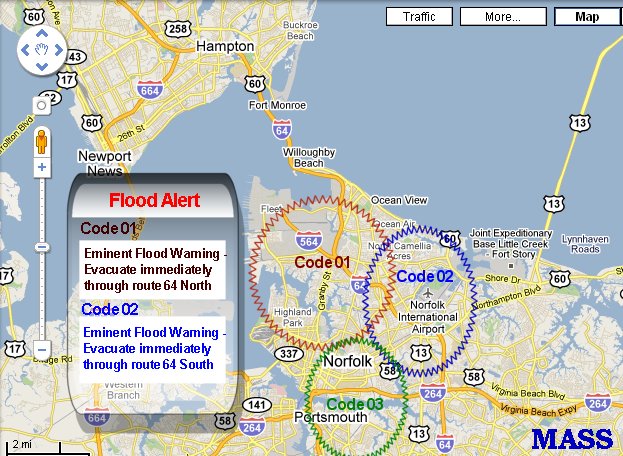
This proposal is designed to suggest an infrastructure that would be put into place for potential disaster preparedness.
The following mechanism could be used in many situations where rapid individual response is needed, including impeding or occurring natural disasters, or security scenarios. Possible scenarios include the need to evacuate a certain area, or prevent people from going to a certain area. The system is based on basic cell phone technology and SMS messaging.
Advantages: This system would be based on commonly used equipment, prevalent all the way from low income to high income individuals. The message can be delivered in high immediacy to people, where ever they are located, due to the mobility of mobile phones.
In addition, the message can be individualized, so that a certain percentage of people could be directed to use one route, or bridge, and another portion of the population would be instructed to use an alternate evacuation route, in order to minimize congestion.
Disadvantages: this solution relies heavily of cell phone technology and digital systems, and would not be likely to work in situations where damage to this infrastructure has been obtained, such as EMP interruption during an unusually intense solar flair, or overload of the cell phone bandwidth. This system would also require a certain amount of cooperation with the cell phone manufacturers.
Description:
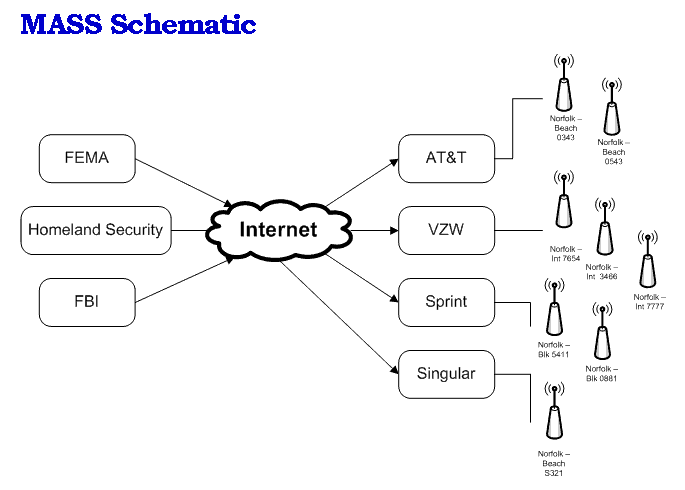
The system relies on a broadcast of text messages to all subscribers of wireless services, through their providers. Instructions could be sent to each mobile phone in an immediate fashion, providing clear instructions where to go, or what precautions to take.
The system could be either by voluntary subscription, which would be the simplest implementation, though that solution would probably miss a lot of individuals who lack the initiative to subscribe to the alert system. Another alternative would be to make the alert system an integrated feature of the service and hardware; such is the case with 911 at this time.
Ideally the system would provide the following components:
- Reverse 911 – Service providers would provide direct access to their subscribers’ phones. This would preempt the need for FEMA, or Home Land Security, to maintain their own up to date database of all mobile numbers.
- Localization – The reverse 911 mechanism would also include GPS based filters, which allow reaching only individuals in a certain geo-location. Older phones that do not include GPS would be identified by closest connection tower node or triangulation.
In the event of an eminent disaster, or an emergency in progress, the agency in question would activate an alert based on geographic localization through a computerized interface with all wireless service providers. This would be done by means of a highly secured Intranet. Wireless service providers would in term relay the text message broadcast to their subscribers at the specified locales. There could be a given ratio of distribution of multiple messages, or multiple messages applied to various nearby geo-locations. For example, one town could be instructed to boil all water for safety, a nearby town could be instructed to avoid drinking any water at all.
Problems & Solutions:
There are a few obstacles to the implementation, though solutions could be given to each through collaborative work with mobile phone manufacturers, as well as wireless service providers, in order to make a few changes in the operation of those networks.
Problem - Overload - In the event of a disaster, it is likely mobile phone use would spike, and the bandwidth required for the alert messaging would be clogged, and render such a system ineffective.
Solution – Emergency Mode - Service providers would switch the phones in their service to a special emergency mode, similar to the 911 lockdown mode, where certain operations are restricted. This would be done to avoid the collapse of the network due to overwhelming of the bandwidth. Such a mode could, for example, include restrictions for talk time in any one call.
Problem – Ignoring of incoming messages – Some individuals may not be likely to check their text messages continuously, or when they are in particular locations, such as restaurants, their office, or in company.
Solution – Identification of emergency messages - Future cooperation with mobile phone manufacturers and wireless service providers could allow for an additional instant messaging protocol. Similarly to MMS a message could be formatted as an emergency message or EMS. This would allow the phones to filter the incoming message and activate a different type of emergency ring, and possibly override a vibration or silent mode.
Possible Scenario:
A coastal area is expected to be subject to flooding. Messages are sent to all individuals currently located at that geographic location, whether resident or visiting. Messages north of a given point are instructed to take route 150, people to the south of that point are instructed to take route 310. People on route 23 are instructed to take service road detour towards route 310.
0 comments