Neighborhood 'Take Charge' Kiosk
Whenever I think back to the days following Hurricane Katrina, I try to enumerate what were the survival tools we lost most quickly or unexpectedly. Then I ask myself, "Which ones could we plan against losing next time?"
The broadest class I conjure up is: electronics. Specifically, cell phones and small portable devices, which are necessary for (re)establishing contact with loved ones and emergency services in times of crisis.
Around the time of Katrina, many cellular providers were caught off guard with respect to the robustness of their own infrastructure (How long can an antenna tower operate on backup power?), as were the customers relying on it (Why did so many cellphones stop working during evacuation?). Those companies learned an important lesson, and safeguards were soon put in place (e.g. better routing algorithms, beefier generators, network piggybacking, etc.).
Over the last five years, consumers have acquired - and become dependent on - many more wireless devices, and those living in hurricane-prone areas tend to be more proficient using them than they were pre-Katrina. But the problem of keeping those devices running becomes gravely acute when no electricity is coming into your flooded home, and your car is sitting in three feet of water!
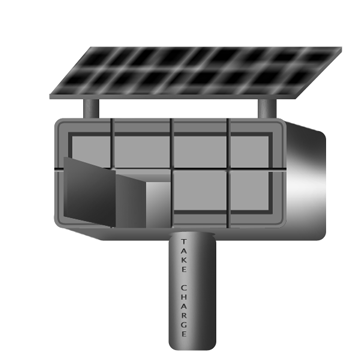
That is why I propose every neighborhood consider adding a community-accessible charging station, which I call the "Take Charge" kiosk, as part of their disaster preparedness plan. Once deployed, this inexpensive solar-powered (12V DC) cabinet would become a permanent, weatherproof fixture where any resident could come charge his own cellphone or laptop by leaving it plugged in inside one of the kiosk's lockers, securing the door with his own padlock. Arrangements might even be made for a take-one-leave-one policy, whereby neighbors could borrow one device while another is charging.
A neighborhood cannot afford to be without communication during or post-emergency; Hurricane Katrina proved that to residents of the Gulf Coast region. Being caught unawares was understandable then, but now that we are armed with the luxury of hindsight, citizens deserve the most robust, seamless set of emergency protocols that society can muster. I believe a "Take Charge" kiosk fills that bill simply and elegantly, at a time when the requisite technologies have matured to make such a thing practicable and affordable.
0 comments