Preparedness Social Networking Toolkit (and perhaps a failure monkey)
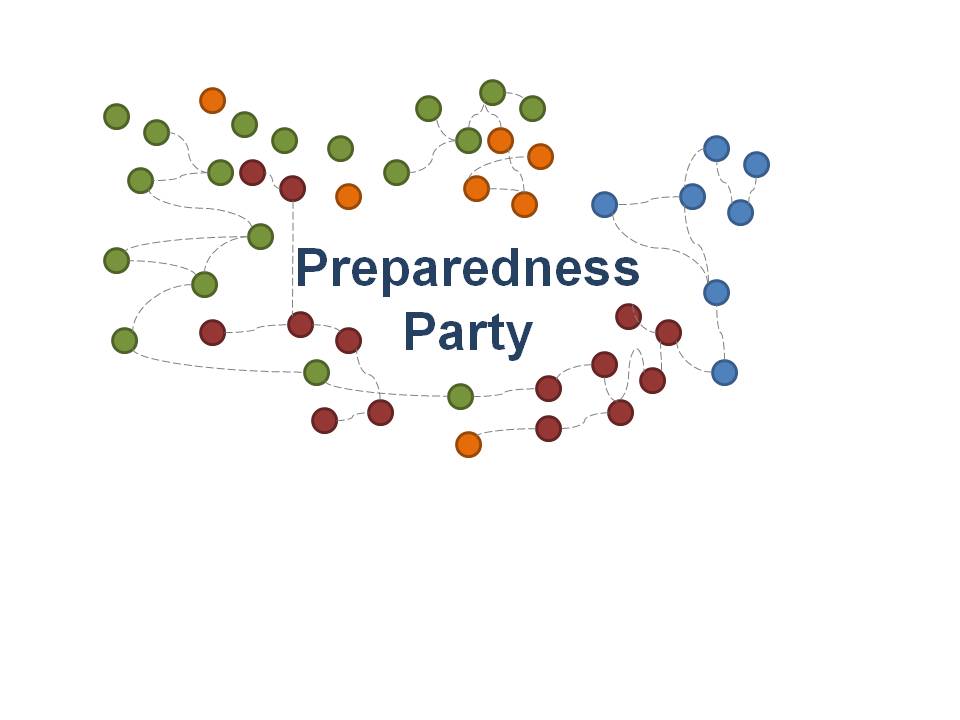
The best way to prepare ourselves, our neighbors, and our communities is through exercises that are fun and easy/cheap. There already exist inaccessible tools like National Exercise Scheduler, Design and Development Toolkit, Corrective Action Plan Tracker, etc. Then there are real working/operational programs like Neighborhood Watch, Fire Drills, Community Preparedness Days (by local church groups etc.). There are also local functional drills and full-scale exercises that are under-attended and over-scripted. We need something in the middle that (1) provides some basic social networking capabilities (like Linked-In) for people with similar interests to find one another, (2) It includes some basic tools for scheduling, designing, and commenting that will help communities lower the costs of their programs like neighborhood watch, preparedness picnics, etc., (3) help connect citizens with basic community events and perhaps even a failure monkey. All three are described below.
(1) Social networking tool
The tool should be free and open, like facebook or Linked-In. It should not be controlled like LLIS, NEXS, or the others. (This should result in a careful design for how official organizations link it.) It could initiate support with a few local church congregations that have active preparedness activities and exist in active communities. (For example, there is a local congregation in Charlottesville, VA that has organized themselves into groups of 10s and 50s with 'preparedness captains' They even do little 'drills' like have a 'do not go to the store week and see what don't have enough of' They then share experiences. These same groups help each other during snow storms, floods, unemployment, etc.. They know each other and so keeping up with phone numbers, emails, chatIDs, etc. is easy) The question is could this be enabled on a larger scale and integrated with community efforts. I know that the Univ. of Virginia recently had a stadium evacuation exercise where they only got about a dozen students to participate as evacuees - there was little awareness in the community because there is no method of networking. My neighborhood has a neighborhood watch that tries to keep track of old people or families with young babies who might need help during storms, etc. Keeping track of contact info. is difficult so we usually just go knock on the door. How many neighborhoods have similar programs with varying levels of organization, sophistication, and security? FEMA could enable this with a very simple (but secure) and open social networking app.
(2) preparedness tools
We all know about the websites like ready.gov, redcross, 72-hours, etc. But all they are is a load of information. But, what is really needed is tools to help us DO what needs to be done. For example, I work over 100 miles away and so periodically my wife will call a 'practice emergency meeting' and we will grab our emergency kits and meet for a meal. Our meeting place is different depending on the type of "practice emergency" we are having. We also have an "indoor campout" where we turn off the power to the house and see what we are missing. The kids love it because we play games and cook "interesting food" from our emergency kits, but it's good for them. It would be nice if the networking app then provided a means by which to have like-minded people try each others' fun/safe ideas. The best way to prepare is to DO. We need tools that help us schedule, calculate, design, develop fun games to do with the kids and neighbors that will help us to be prepared - but also provide they things we do anyway like hang-out, build relationships, help each other, etc.. We also need tools that help us in our neighborhood watch, our community training, our participation in community events, etc.
(3) connecting with community and the failure monkey
Another example, each year our community does a 5k for the local fire department, but we have limited ability to get the word outside of our neighborhood. A preparedness social network would enable someone to input their profile and ask the tool "what can I do" and it could spit back a list of things like 5k races, building kits, doing family exercises, neighborhood games, communitity events, etc. They could rate the activities like you rate moview in "Netflicks" and the system could learn what profiles do what sorts of things and improve its ability to recommend preparedness activities. The creator of the tool would be able to look in the aggregate and see what kinds of things are helping people and communities get ready and where might they be able to improve community offerings. Universities might get access to aggregate information to understand correlations to community crime rates and emergency response, communication, etc. Perhaps communities could get access to their aggregate information to advertise the level of preparedness.
What if in addition to the private citizens we got local businesses to participate? What if it could be linked to the DHS Infrastructure Protection Private Business Certification tool to enable exercising of local businesses? Particularly, those that benefit from people making preparedness investments could have incentive to participate. We could have community activities. For example, Wal-Mart could declare a "Snow-storm Day" and recommend sale items for getting ready for a snow storm on a particular cold day. A power company could set up a time slot for a 15-minute power outage activity and send out information to any businesses that would be interested in participating on how to maintain business continuity, etc. (of course they won't really turn out the power). Netflix system actually has a failure monkey that surfs there system and randomly causes outages, yet we feel that there system is flaw-less (and it is because they have designed the system to be resilient to the failure monkey that we never see any major netflix outages)
A social network supported by a toolset to help ease the learning curve of those who want to DO something could enable a network of informed citizens that would be able to care for themselves and their communities. Such would have a greater impact that a specially trained citizen corp, because it would distribute the burden onto the people. Ultimately, once the system reaches a critical mass of networks between individuals and their communities then it would sustain itself with private businesses and communitites marketing their reliability.
This is the way of democracy free choice, but total responsibility (and little uncertainty in the middle because you never know how networks of people are going to act collectively).
0 comments