Rail Safe Harbor
EXECUTIVE SUMMARY
Locally based inexpensive multi-use base sites (e.g. Warehouse design) across the National Rail system to house, treat and/or evacuate populace on a temporary short term basis for a few days before, during or after a disaster event. FEMA heavy resources respond to each location within 6 hours via freight rail utilizing pre-positioned stock less than 300 track miles away, thus permitting directed heavy equipment and personnel to swiftly insert anywhere across the entire lower continental U.S. (lower 48). Use of rail insertion retains controlled flexible and scalable charateristics while avoiding conflict with evacuating traffic on the local highway network. No local on site storage of large scale FEMA emergency supplies is required.
People assemble at a local (in Home County) Rail Safe Harbor site for assistance either before or after a disaster. FEMA train set rolls in with gear and trained personnel. Train engine provides electric power to Rail Safe Harbor Station Site, if needed. Populace is treated at site or transported to another Rail Safe Harbor site about 150 to 250 miles away from the event. This reduces automobiles from the evacuation routes and keeps traffic moving. People are moved only a short distance to another standardized Safe Harbor site, if needed, for a few days and then can return.
This is NOT a request for regular commuter rail. This IS a request for emergency lift and supply via cooperative communities and funded freight railroad company capabilities.
Rail Safe Harbor station sites can be powered up by the Diesel Electric Train engine, as needed, apart from the local electric grid which may be damaged. Each county or locality hosts at least one (1) Rail Safe Harbor site that has dual usage capabilities for peacetime versus emergency events. Peacetime usage can be private warehousing or public hall use, with proviso that all private industry materiel can be fork lifted out of hall in under 6 hours in order to transfer usage to Rail Safe Harbor - hence dual use and potentially self-funding.
REASONING AND CONSTRUCTION OPPORTUNITIES
Building site (warehouse style) options along the current national rail system creating non-competitive quick entry of heavy Federal Emergency Management Agency (FEMA) elements within 6 hours to all areas of Continental U.S. in a rapidly scalable manner.
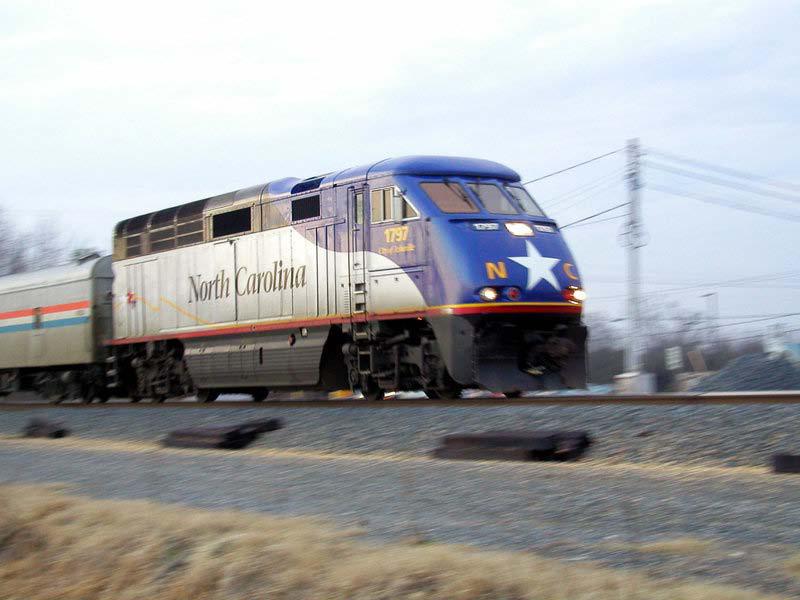
Emergency power is supplied by Railroad Train set, existing diesel electric locomotive engines which are all essentially ELECTRIC GENERATORS on wheels - this is how ALL modern freight train engines currently operate. A single modern locomotive generates enough amperage to power over 1000 homes. Supplying power to the middle of the disaster area can be easily achieved if there is a base station platform pre-configured to receive it. There is very little modification, if any, that needs to be done to our current national stock of train engines and they are all interchangeable.
Each Rail Safe Harbor site provides for emergency treatment and evacuation of populace in a sustainable manner. Achievable building leasing, contract and/or construction results can be quickly realized with decent return on dual use investment, thus creating local self-financing maintenance within an existing national command system framework. Possible re-programmed use of upgraded older facilities may prove opportune. Concept has local and national appeal to employ workers both short and long term. Also utilizes expertise of military veterans and transport workers. Peacetime usage can be low cost leasing of warehouse space to private industry with access to railhead - this is a self financing opportunity.
Populace is not easily convinced to leave behind their automobiles, but this creates an evacuation problem. Moving folks only 150 miles or so gets them out of harm’s way and allows them the flexibility of easily returning. This may convince populace to get on a train or bus in the first place if they can be assured of arriving at a safe and secure destination not too far from home with the knowledge that they can easily return. Standard AMTRAK cars hold 84 people, commuter cars hold even more. Pull a train of ten (10) passenger cars and you can quickly move upwards of 1000 people at one time. Can use a variety of methods to evacuate (e.g. Bus), but Rail Safe Harbor site serves as a reliable, safe and secure powered station which can also serve as a short term refuge.
Site prep takes time, which is not always available on sudden notice. Having a supply of ready to go adaptable sites along the existing rail network allows a flexible and scalable response to emergent situations. We do standardization of systems all the time in military and government applications. Having a flexible receiving site in each host community avoids the Hurricane Katrina moments of people packed into empty ball parks with no services provided. The Rail Safe Harbor site also allows local first responders to interface in assistance via a common plan that can be practiced regularly in advance of need.
For too long FEMA has been viewed as only re-active after the crisis hits. This inserts FEMA quickly in front of the problem via the national rail network without much expenditure of effort or time. Massive amounts of heavy pre-packaged cargo can be quickly maneuvered to site along with portable hospital, feeding and hostelling facilities. There is no conflict with vehicular roadways that may be clogged with evacuating traffic.
Due to recent advances in positive train control technologies, heavy rail engines are more easily and quickly directed than vehicular highways, thus allowing for large volume priority movements. Additionally, the clearing of train tracks can be accomplished in a quicker more focused manner than debris choked highways. Removal/replenishment of equipment is also easily accomplished by rail. Such dual use operation of the Rail Safe Harbor Station site results in a small footprint that is regularly utilized, maintained, adaptable and acceptable to the local community.
After powering up the Rail Harbor Station site with the FEMA train set, then responders can bring in local commuter or AMTRAK passenger trains, or buses to move people. FEMA personnel man the Rail Safe Harbor station and move populace in/out as per their evacuation and return plans. Interchangeability of Rail Harbor site mission sets allows a flexible and interchangeable response to crisis by uniting various communities in assistance to one another. Local, state and federal players all take a part.
Idea has elements of the old Civil Defense Shelter of the 20th Century cold war era or even the Grange Halls of the 19th Century; yet this proposal does NOT REQUIRE STOCKING each Rail Safe Habor site building, merely just designing a multi-purpose dual-powered base station. Recall that the old grange halls were multi-purpose open community spaces, but now bring them up to modern standards and locate along key rail routes. To the degree that each community participates and takes 'ownership' of the Rail Safe Harbor site, the easier it will be for people to avail themselves of the site service with transport or host duties when a true crisis occurs.
Current warehouse sites along existing rail lines may already be available to modify for such usage, but a prime element is to continuously maintain dual use flexibility. Additionally such a site would provide host communities with some minor funds and the ability to fit into the needs of FEMA systems without having to provide continuous on-site stocking and personnel. Private industry may also find this advantageous for some inexpensive warehouse space with access to the rail network.
SPECIFICATIONS (Subject to much greater expansion and detail):
Mission Sets - Purpose to which Rail Safe Harbor Station must potentially conform:
a. Treatment site – Short passenger duration (1 night max).
b. Export transit site – Extremely short passenger duration (hours to 1 day).
c. Receiving and transit site (Refuge/Evac site) – Limited passenger duration (2 to 3 nights).
Evacuation Planning – Move (passengers).
- Distance to safety? (E.g. 100-250 track miles). At what point can we get people to leave behind their 2000 lb anchors, namely their cars (POV: Personally owned vehicle). Far and safe, but neither too close nor too far.
- Refuge Site – Limit stay at delivery point. Better to get people away from rail refuge site (delivery point) ASAP. Use local resources, local Hospitals/Hotels.
- Train set Conductor Union Input; Crew Rest and Overtime issues (consult Train workers union).
FEDERAL RESPONSE CARE AND RAIL LIFT (FRCARL Site/Train)
Site Specs - Standardized
- Location: Away from central city – Allow plenty of excess auxiliary storage for parking and expansion spaces. Avoid floodplains such as harbor and coastal sites - be inland and above high water marks.
- Secure site from heavy weather dangers. (E.g. Higher Ground – No dangerous wildlife).
- Type - Single story building – avoid costly multiple story structures.
- Ease of access to utilities and piping network. Must also accept inputs/transfer to Rail Engine Power.
- Parking lots (guarded?) - Alternate area parking lots with shuttles?
- Pets (if evacuating, how are pets to be handled?)
- Bus & light rail connection point options.
- Handicap access.
- Safety controls for track conditions to prevent injury to populace from rolling stock.
- Raised Platform access (including ramps) for quick and direct loading of passengers into rail cars if using rail evacuation/return.
- Bus loading dock area if using motor coach evacuation/return.
- How many sites and spacing: Population size determinants. Keep within 300 track miles to initial FEMA train set storage - approximately 12 teams across continental US (lower 48). Possible mission for National Guard units.
FEMA Train Set Rolling Stock – Initial roll out requirements (Engine plus 4 cars):
- Locomotive – All newly minted Diesel Electric Engines to be required to have electrical and air power support exports to new Rail Harbor station inputs. If needed, augment funding like military does for commercial airplane and ship support lift specs. Add utility cars (see below) so as not to overburden Locomotive manufacturers. Use coupled engines to provide additional power. Locomotive Engine is a power platform only.
- Fuel Tank car and/or re-fueling availability (all perm train set cars are single height).
- Auxiliary Boiler / HVAC input car – to transmit into station site.
- Crew Quarters /Feeding Car.
- Utility Crane Car (possibly self powered) – Fuel/Water Hoses, Electric cables (support train set and building inputs) – self-repairs / site-repairs / site-clearing / minor track clearing and repair. Car placement can be before engine or at end of train set depending on need of track conditions and cargo movement.
- Initial train set and staff to be self supporting – this is the tip of the spear.
- Extra Cars (e.g. Hospital, Large Food service, Passenger movement, etc) - These can be added or removed at later points after the initial train set roll in. Keep these in reserve or circulation. Reduces the need to staff extra equipment.
Site Track zones (ALL Safe Harbor Sites):
- Wye (‘Y’) turnaround track or equivalent. Must have ability to fully reverse train consist sets to include passenger trains.
- Siding (s) configurations - Contact Railroads (CSX, NS, etc. and Circus)
- Main through track interlocking (entrance/exit) and distances to main track - Minimize interference with main lines at a reasonable distance - thus avoiding complaints from railroad companies. Remember that this is for emergency use. Peaceful usage can be contracted with private industry and rail companies. Railroads might find this advantageous to them and legally allows U.S. Govt to augment Railroad 'right of way' maintenance financing.
- Ease of continuous maintenance for rolling stock (dual use) – Get buy in from rail companies to maintain, lease, use the track space for non-emergent purposes.
- Right of Way and Trackage Issues - Currently there already exists hundreds of no longer used but available right of ways throughout most of the U.S. that railroad companies either no longer want to maintain or use due to cost issues. If U.S. govt provides some funding these are prime areas to be cheaply and quickly transformed into Rail Safe Harbor sites.
Recommend prototyping in the hurricane or tornado prone areas of the central U.S. continent. Inexpensive cost of land and building projects in this area will provide easier funding opportunities to prove concept. After prototype work is accomplished envision approximately twelve(12) fully stocked train sets spread across the continental U.S. to fully access the entire lower 48 in under 6 hours. Each train set should have a radius of operation under 300 track miles so as to achieve destination in under 6 hours. Circus companies can provide guidance on how to pack the FEMA train consists since they regularly move about the nation on circus train sets. Additionally ANY diesel electric locomotive could potentially power up a Rail Safe Harbor site, thus allowing for leased emergency backup coverage provided by railroad companies, short line railroad companies in particular since they are localized - this exponentially expands the effective coverage area across the continent.
We can provide greater granularity of this proposal as needed but also appreciate any other good ideas that others may provide.
CONCLUSION
During emergencies we have a locally overburdened vehicular highway network parallel to an underutilized rail system. Please share the wealth of our current technology which allows first responders to work in cooperation with rail systems vice fighting them. Also allows the populace to appreciate the value of rail and rail sites which will certainly mitigate and possibly inoculate our communities against the crippling effects of natural disasters.
0 comments