Localize FEMA
FEMA has a huge asset most organizations do not posses, a nationwide staff passionate about helping people. Furthermore, FEMA staff has specialized knowledge, training and experience in disaster management. FEMA can promote community involvement in disaster preparedness by localizing community access to the heart and brain of FEMA, the staff.
Localize FEMA communication channels.
Localize FEMA Facebook pages by state. Place them under the control of the respective FEMA regions. For example, Region IX could manage Facebook pages such as FEMA California, FEMA Nevada, FEMA Arizona, FEMA Hawaii as well as the IX territories. Each state Facebook page will need a place to provide more in-depth resources than Facebook allows; GIS maps, blogs, document downloads, etc. Consequently, the FEMA.gov web site may be a good place to provide local spaces for each FEMA region to utilize. A URL might take the form www.fema.gov/prepare/california. The blogs and resources under that URL could be operated by Region IX staff conducting preparedness coordination within California.
Create personalized Twitter accounts for FEMA staff engaged in community preparedness coordination. Comcast Communications runs a highly successful Twitter campaign (http://twitter.com/comcastcares). Members of Comcast operate accounts such as @ComcastBill to support @ComcastCares. FEMA should create similar accounts such as @FemaBill to support a @FemaCalifornia or the existing @Femaregion9.
Localize FEMA staff.
Once the localized channels are created, focus relentlessly on local threats and preparation. @FemaBill can tweet about his preparedness meeting with the Alameda County Emergency Manager on hillside fire threats and he can Facebook what he learned at a RISC meeting about Bay Area earthquakes. @FemaBill can then expand that information on the localized www.fema.gov/prepare/california site. But, @FemaBill obviously won't have much to say about gulf coast hurricane preparedness in California.
Measure local engagement.
FEMA management should be able to look at each local FEMA Facebook page, Twitter account and localized FEMA.gov page and witness involvement relevant to that local community. Evidence of success will be when a Bay Area church pastor (or any community leader) retweets an @FemaBill link to a flip-cam video on preparing for threats specifically related to the San Francisco Bay Area. Or, even better, when @FemaBill shoots a flip-cam video of an elementary school principal explaining how he is using FEMA provided resources to teach his students about disaster preparation.
Benefit from localized diversification.
As @FemaBill and the other FEMA staff learn how to successfully engage communities through Facebook, Twitter and FEMA.gov they will have the opportunity to learn from one another about what does and does not work. It is much easier to compare the relative success of localized channels than it is to gauge the success of preparedness posts generalized to work on the single national FEMA channel. Thus, FEMA management will be able to quickly identify methods of success and distribute those lessons to the localized channels.
Summary
If community participation in disaster preparedness is the goal, FEMA must connect its people to the community. And that happens through relationship making and relevancy. Localizing access to FEMA staff through slight modification of tools aready in use by FEMA is fairly inexpensive. But localization will vastly improve FEMA's ability to deliver preparedness resources relevant to specific communities.
Thanks for letting me participate.
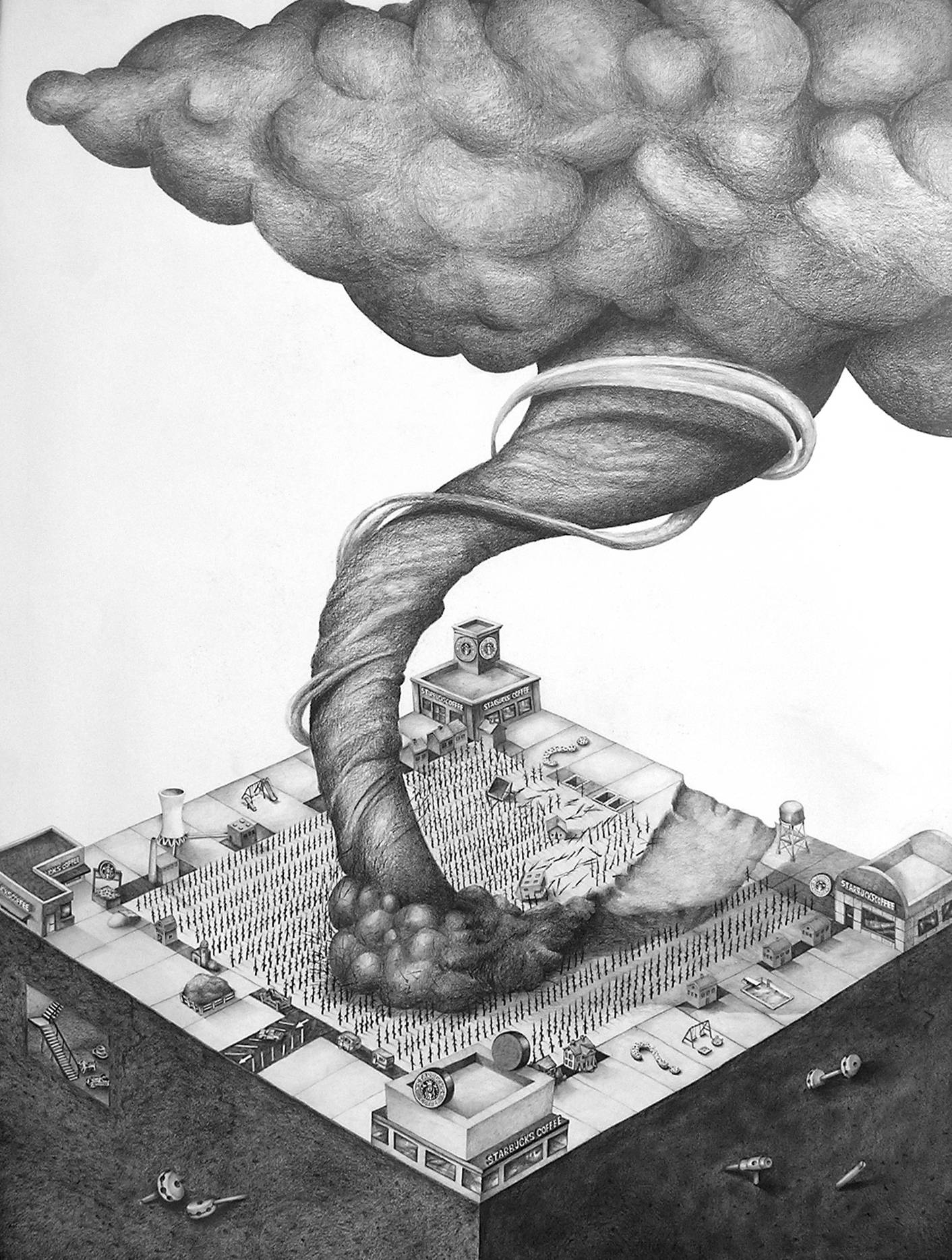
(photo, graphite on paper "Chance" by Rob Rough - click on the photo to enlarge it - i especially like how there is a Starbucks on every corner.)
0 comments